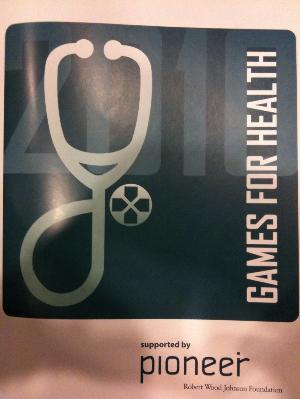
It’s time for the 6th annual Games for Health conference. The conference, in partnership with the Robert Wood Johnson Foundation, provides a forum for experts in the fields of video games, healthcare, and science to come together and share the latest and greatest in health-related video game news and research.
From their promotional pamphlet:
Because digital games can actively engage and challenge people of all ages, they have the ability to help individuals manage chronic illnesses, support physical rehabilitation, pursue wellness goals and contribute to changes in health behaviors. Public health leaders, doctors and nurses, rehabilitation specialists, emergency first responders and other health professionals are also using games and game technologies to advance their skills and enhance how they deliver care and services. Games are even beginning to mine the wisdom of the crowds to forge critical new discoveries in biology and genomics.
The acceptance of games as a valuable health management and training method, the popular success of consoles like the Nintendo Wii, and the growth of smartphone game applications indicate that there is tremendous potential for continuing to move health and behavior change activities beyond clinical settings and the classroom and into consumers’ home, work, social and recreational spaces.
We’ll be reporting throughout the event (May 25-27). Stay tuned for info on the PS3 Move, a Wii laparoscopic trainer, and more.
*This blog post was originally published at Medgadget*
Yep, you read that right. The Chicago Public Schools, not exactly known for quality education, have a plan for training our future healthcare providers — high school:
Chicago Public Schools this fall will open the city’s first high school specializing in healthcare, a move local hospitals hope will help relieve chronic workforce shortages.
The school, which recently used a lottery system to enroll a freshman class of 160, will have a heavy emphasis on math and science. Juniors and seniors will be able to earn credits by shadowing hospital workers and interning as assistant nurses and in other professions.
Planners aim to prepare students for health- and science-related college programs and certify them for entry-level jobs in healthcare, such as pharmacy technicians or assistant physical therapists.
I didn’t turn on the computer yesterday (yes, it was glorious), so I missed Mother’s Day coverage in our local newspaper. When we returned home, I was happy to see that on the front page of the print copy the dean of Duke School of Medicine, Nancy Andrews, M.D., Ph.D., was featured with her daughter in the lab on their “fun Saturdays” together.
Also cited and pictured in the article was Duke vice dean for research and professor of pharmacology and cancer biology, Sally Kornbluth, Ph.D., and her daughter.
Written by News & Observer science editor Sarah Avery, the article describes how women are increasing in ranks in biomedical degrees earned while still lagging at the associate professor level and up. This trend was cited specifically for faculty and administrators in basic science departments of medical schools, but is widespread in academic science and engineering. Read more »
*This blog post was originally published at Terra Sigillata*
The House of Commons Science and Technology Committee (STC) has released a report, Evidence Check 2: Homeopathy, in which they recommend that the NHS stop funding homeopathy. The report is a rare commodity – a thoroughly science-based political document.
The committee went beyond simply stating that homeopathy does not work, and revealed impressive insight into the ethical, practical, and scientific problems caused by NHS support for an implausible and ineffective pseudoscience. Read more »
Last week’s CDC report, “Health, United States, 2009” confirms that Americans are increasingly turning to medications, scans, and procedures to improve their health. Exercising, eating right, and weight loss: not so much.
Don’t get me wrong. I love technology as much as the next guy. Maybe more. I’m writing this on a laptop while jetting from California to New York. My iPhone, Blackberry, and Kindle are all within ten feet of me. But my inner Luddite is starting to stir. Read more »
Latest Tweets from @DrVal
Could not authenticate you.
Better Health Audio
Featured Audio
Healthy VisionTM with Dr. Val: Safe Contact Lens Wear and Care
It’s no secret that doctors are disappointed with the way that the U.S. healthcare system is evolving. Most feel helpless about improving their work conditions or solving technical problems in patient care. Fortunately one young medical student was undeterred by the mountain of disappointment carried by his senior clinician mentors…
I am proud to be a part of the American Resident Project an initiative that promotes the writing of medical students residents and new physicians as they explore ideas for transforming American health care delivery. I recently had the opportunity to interview three of the writing fellows about how to…
I m often asked to do book reviews on my blog and I rarely agree to them. This is because it takes me a long time to read a book and then if I don t enjoy it I figure the author would rather me remain silent than publish my…
When I was in medical school I read Samuel Shem s House Of God as a right of passage. At the time I found it to be a cynical yet eerily accurate portrayal of the underbelly of academic medicine. I gained comfort from its gallows humor and it made me…
I am hesitant to review diet books because they are so often a tangled mess of fact and fiction. Teasing out their truth from falsehood is about as exhausting as delousing a long-haired elementary school student. However after being approached by the authors’ PR agency with the promise of a…



 It’s time for the 6th annual Games for Health conference. The conference, in partnership with the Robert Wood Johnson Foundation, provides a forum for experts in the fields of video games, healthcare, and science to come together and share the latest and greatest in health-related video game news and research.