Phobias, such as the fear of flying, elevators or public speaking can disrupt people’s lives. Dr. Jon LaPook talks with psychologist Robert Reiner about how to overcome these fears with the help of virtual reality.
Washington has become a place where nothing can move, advance or happen. Having been paralyzed by a huge snowstorm over the weekend, the federal government has been closed since Monday, our roads are clogged with unplowed snow, our Metrorail system won’t run above-ground trains, the schools are closed (until June, it seems)–and to top it off, another 10-20 inches of snowfall is expected in the next 24 hours. (Yes, our trains really don’t run when we get more than a few inches of snow. You Chicagoans can stop laughing now.)
Of course, the snow and ice will eventually melt, and Washington will get back to normal. Not so the partisan gridlock that apparently will prevent anything from getting done even when the government reopens for business. Read more »
E-cigarettes continue to create a lot of media buzz and chatter among smokers and smoking cessation experts alike. Today, Professor Thomas Eissenberg of Virginia Commonwealth University published an important study demonstrating that E-cigarettes, despite claims on the packaging and advertising, deliver almost no nicotine to the user.
The study is published in the latest edition of the journal, Tobacco Control. Professor Eissenberg had 16 smokers abstain overnight, then come to the lab. on different days and (a) smoke two of their usual cigarettes (b) puff on two unlit cigarettes or (c) “smoke” 2 leading brands of E-cigarette using their “high nicotine” cartridge (16mg), each brand on a separate occasion. On each occasion he measured the blood nicotine levels before, during and up to 45 minutes after using the products. Read more »
I received a free copy of the book, Genius on the Edge: The Bizarre Double Life of Dr. William Stewart Halsted by Gerald Imber, MD, a week ago. I have enjoyed reading it. The book is the biography of Dr Halsted, but also gives you a glimpse into the life of many other great medical figures: William Osler, William Henry Welch, Harvey Cushing, etc. (photo credit)
In many ways it is a history of medicine/surgery in America. Halsted was very influential in bringing aseptic techniques to surgery and introduced the residency training system. He used his knowledge of anatomy to improve surgical technique. He performed the first successful hernia repair and radical mastectomy for breast cancer.
Early in his career Halsted became addicted to cocaine while experimenting with the drug for use as a local anesthetic. Treatment at the time, involved substituting morphine for cocaine. Halsted spent 40 years of his life struggling with his addiction to both cocaine and morphine. Read more »
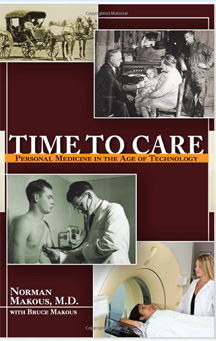
In 1925, Francis Peabody famously said “The secret of the care of the patient is in caring for the patient.” A new book by Norman Makous, MD, a cardiologist who has practiced for 60 years, is a cogent reminder of that principle.
InTime to Care: Personal Medicine in the Age of Technology, Dr. Makous tackles a big subject. He attempts to show how modern medicine got to where it is today, what’s wrong with it, and how to fix it. For me, the best part of the book is the abundance of anecdotes showing how medicine has changed since Dr. Makous graduated from medical school in 1947. He gives many examples of what it was like to treat patients before technology and effective medications were introduced. He describes a patient who died of ventricular fibrillation before defibrillators were invented, the first patient ever to survive endocarditis at his hospital (a survival made possible by penicillin), a polio epidemic before polio had been identified as an infectious disease, the rows of beds in the tuberculosis sanitariums that no longer exist because we have effective treatments for TB. Read more »
It’s no secret that doctors are disappointed with the way that the U.S. healthcare system is evolving. Most feel helpless about improving their work conditions or solving technical problems in patient care. Fortunately one young medical student was undeterred by the mountain of disappointment carried by his senior clinician mentors…
I am proud to be a part of the American Resident Project an initiative that promotes the writing of medical students residents and new physicians as they explore ideas for transforming American health care delivery. I recently had the opportunity to interview three of the writing fellows about how to…
I m often asked to do book reviews on my blog and I rarely agree to them. This is because it takes me a long time to read a book and then if I don t enjoy it I figure the author would rather me remain silent than publish my…
When I was in medical school I read Samuel Shem s House Of God as a right of passage. At the time I found it to be a cynical yet eerily accurate portrayal of the underbelly of academic medicine. I gained comfort from its gallows humor and it made me…
I am hesitant to review diet books because they are so often a tangled mess of fact and fiction. Teasing out their truth from falsehood is about as exhausting as delousing a long-haired elementary school student. However after being approached by the authors’ PR agency with the promise of a…