October 13th, 2009 by Berci in Better Health Network, News
No Comments »

I’ve recently come across AcaWiki, an interesting project focusing on academic research and web 2.0.
Today, representatives from the new nonprofit project AcaWiki announced the opening of their website to the public. AcaWiki’s semantic-wiki based website allows scholars, students, and bloggers to easily post summaries, and discuss academic papers online. All content posted to the site is licensed under a Creative Commons Attribution license.
AcaWiki’s mission is to make academic research more accessible and interactive by creating a “Wikipedia for academic research.” “Cutting-edge research is often locked behind firewalls and therefore lacks impact,” founder Neeru Paharia explains, “AcaWiki turns research hidden in academic journals into something that is more dynamic and accessible to have a greater influence in scholarship, and society.” AcaWiki enables users to easily post and discuss human-readable summaries of academic papers and literature reviews online. AcaWiki also helps users to share and organize summaries through the use of tags and RSS feeds.

*This blog post was originally published at ScienceRoll*
October 13th, 2009 by Dr. Val Jones in Expert Interviews
No Comments »
 OptumHealth is one of the largest health and wellness companies in the United States, providing services to about 58 million people. It is the umbrella organization for 12 consumer-directed healthcare companies recently purchased by UnitedHealth Group. I caught up with the CEO of OptumHealth Care Solutions, Rob Webb, at Health 2.0 to find out what they’re up to and how they’re hoping to contribute to healthcare reform.
Dr. Val: What does Optum Health do?
Webb: We work with about 300,000 people a day. We’re focused on the consumer-provider interaction and we try to help consumers make better decisions in four key areas: 1) help them find the right provider for their needs, 2) to provide them with an unbiased set of information about what their treatment options are 3) optimize their pharmaceutical regimens and medication compliance and 4) help them improve their lifestyle choices. In the past we focused a lot of our efforts on #3 because it’s so tangible and there’s an entire PBM (pharmacy benefits management) industry to help. Read more »
October 12th, 2009 by DrWes in Better Health Network, Health Policy, Opinion
No Comments »

From “War on Specialists” in the Wall Street Journal:
Take a provision in the Baucus bill that would punish any physician whose “resource use” is considered too high. Beginning in 2015, Medicare would rank doctors against their peers based on how much they cost the program—and then automatically cut all payments by 5% to anyone who falls into the 90th percentile or above. In practice, this rule will only apply to specialists. , Read more »
*This blog post was originally published at Dr. Wes*
October 12th, 2009 by KevinMD in Better Health Network, Humor, True Stories
1 Comment »

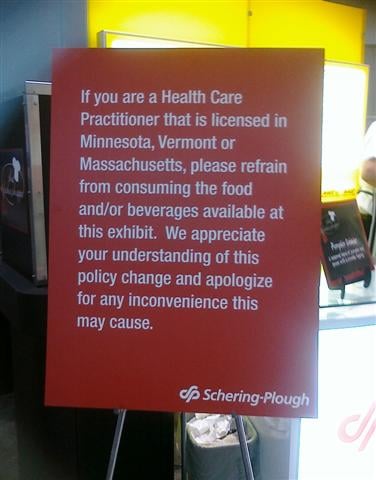
And that includes food of any kind, which makes for some awkward moments at national physician conventions.
So, during this week’s ACEP Scientific Assembly in Boston, WhiteCoat snapped a picture of this notice, which borders on farcical:
Read more »
*This blog post was originally published at KevinMD.com*
October 12th, 2009 by GruntDoc in Better Health Network, News
1 Comment »

EMS/ED frequent fliers are both a bane and (supposedly) another cost of doing business for EMS systems. Maybe not.
My city of Fort Worth is trying to do something about it, proactively and correctly (emphasis mine):
MedStar program sends paramedic to homes of some repeat callers before they dial 911 | Fort Wor…
FORT WORTH — Last year, MedStar was called more than 800 times by 21 people.
Those “frequent fliers” weren’t necessarily facing life-threatening emergencies. Some may have needed primary care but didn’t have a regular doctor or transportation. Read more »
*This blog post was originally published at GruntDoc*












